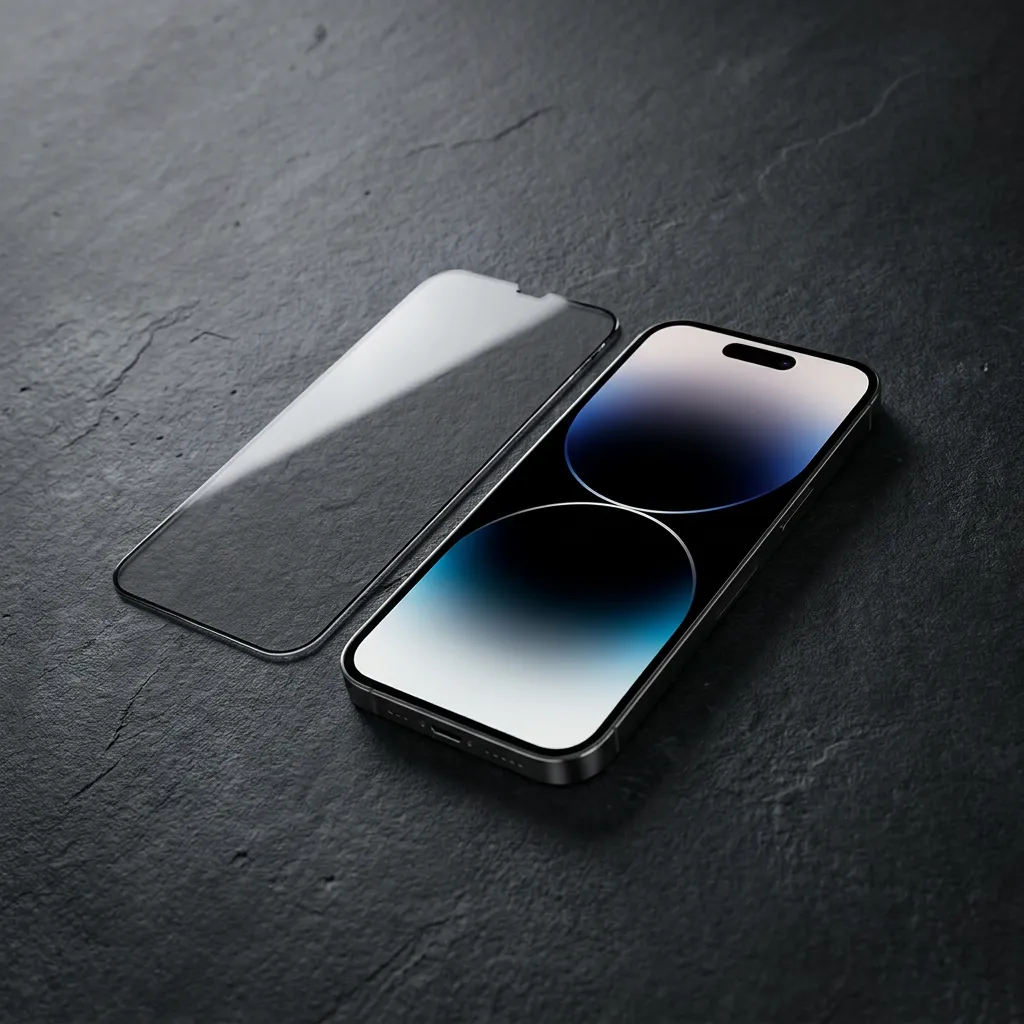
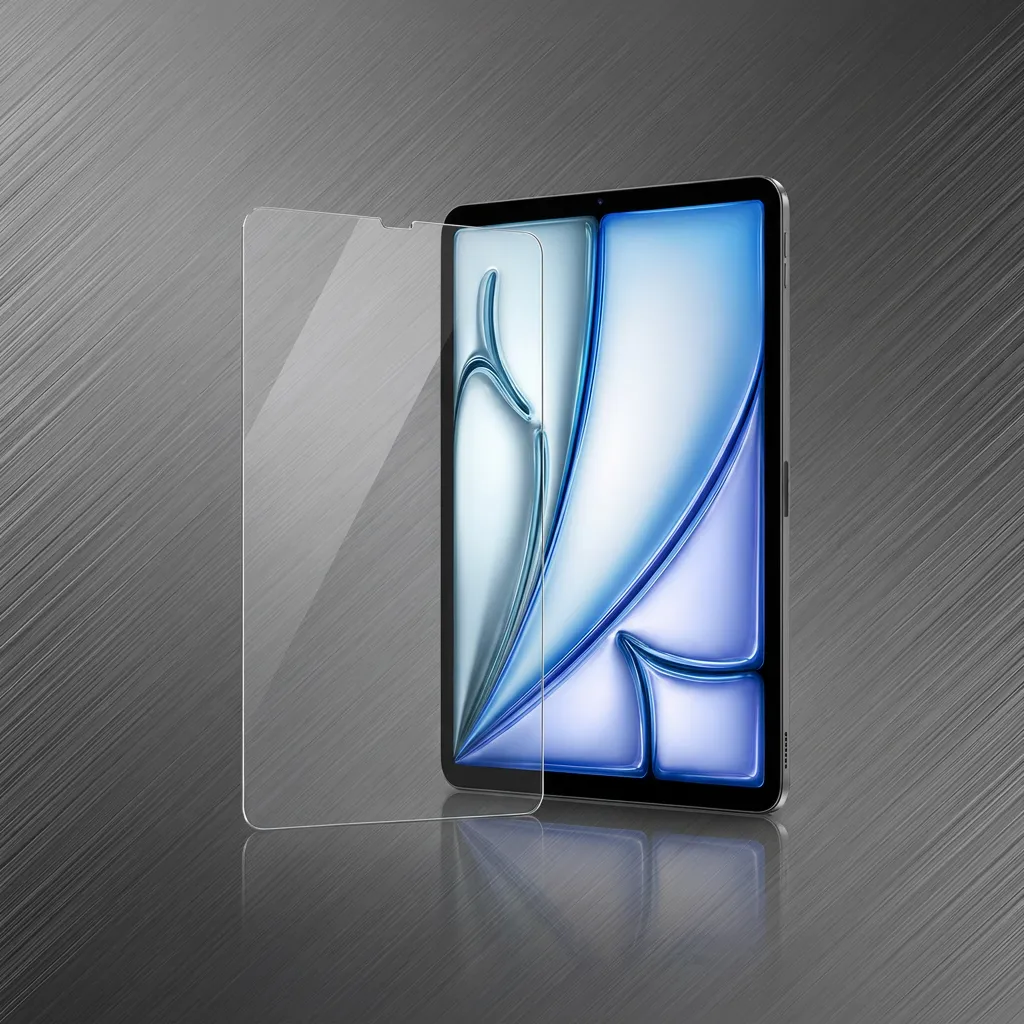
A magnetic privacy film and a full-glue one carry the same louver sheet. What differs is how that sheet stays on the glass — and that one difference decides whether it survives a backpack.
Both get sold as "removable" and "easy install," which tells you nothing. One lifts off with a fingernail and can be re-seated ten times. The other is laminated to the panel and never comes off intact. One of them is wrong for your iPad, and the test takes ten seconds.

A full-glue film is laminated: an optically clear adhesive bonds the entire panel to the film, edge to edge. No air gap, so no second reflective surface, and nothing to shift. The cost is commitment — lifting a corner means replacing the film, and dust trapped at install stays there.
A magnetic film carries a thin steel frame that grabs the magnet array already inside your bezel — the same one that holds a Smart Cover. It sits a fraction of a millimetre proud of the glass and comes off with a fingernail. That gap is the whole story: it is why the film is removable, and why it has three failure modes the laminated version does not.
One situation, mostly: the iPad gets handed to someone. In a client meeting you peel the film off, turn the screen around, and put it back when the conversation moves on. Same in a classroom demo, or when a colleague asks to see a document. A laminated film forces the other person to sit at your angle — exactly the constraint you bought the film to escape.
It also forgives a bad install: lift, re-align, done, no residue. Our 180° magnetic privacy screen for iPad 11th / 10th generation is the version most people land on for this use, at $19.99.
Everywhere the iPad travels. In a backpack or a tote the magnetic frame catches on the sleeve and the film creeps. Shared family tablets are worse — children pick at any edge that lifts. And if the tablet lives inside a folio case, that case covers the bezel magnets, so the film has nothing to grip and the removable feature quietly disappears.
For those, the 360° full-glue privacy screen for iPad Pro 11 / 13 is the honest buy: thinner stack, no gap, nothing to slide. Both cost $19.99, so price is not the tiebreaker here.
| What matters | Magnetic | Full glue |
|---|---|---|
| How it holds | Steel frame on bezel magnets | Adhesive over the whole panel |
| Removal | Fingernail, reusable | Destroys the film |
| Air gap | Yes, sits proud of the glass | None |
| Stray reflections | Faint second image of ceiling lights | Single surface |
| Stability | Can creep out of alignment | Fixed for good |
| Dust | Collects along the frame edge | Sealed at install |
| Bad install | Fixable in seconds | Not fixable |
| With a folio case | Needs exposed bezel magnets | Works under any case |
Magnetic films rarely fall off. They slide.
The drift is slow and small, which is why owners blame their own install. Three things break, in order. First the cutout: the camera and ambient-light window stop sitting over their holes, and the film's edge shows a bright seam against the black bezel. Then the viewing cone — on a 180° film, a couple of millimetres of lateral shift tilts the louver stack, and the person beside you starts catching content at an angle that used to read black. That is the one that matters, because it fails silently: the screen still looks private from where you sit.
Second, dust. An air gap is a place for lint to gather. Grit trapped under a sliding frame eventually marks the coating it rides on.
Third, the gap itself. Two glass surfaces with air between them reflect twice, which is why a magnetic film under office downlights shows a faint second image of the fixtures. You notice it on dark content.
Not "which is better." Ask instead: does this iPad leave the desk?
| Your situation | Buy | Because |
|---|---|---|
| Rides in a backpack or tote daily | Full glue | The frame catches on the sleeve |
| Shared with family or children | Full glue | Any lifting edge gets picked at |
| Lives inside a folio case | Full glue | The case hides its magnets |
| Handed to clients, students, colleagues | Magnetic | Seconds off, seconds back on |
| Desk-bound, occasional video calls | Magnetic | The gap costs least when nothing moves |
| Both — travels and gets handed over | Full glue | Removability only pays if you use it |
If the tablet is shared by more than one person all day, the constraint is usually the room rather than the film — our guide to shared and semi-public settings covers that case.
No. It holds the way a Smart Cover holds. The risk is drift, not detachment.
Only if the case leaves the bezel magnets exposed. Most folios do not.
Full glue — it behaves closer to bare glass. A magnetic film's air gap lets the panel give slightly under the tip, which reads as a soft click on fast strokes. The Pencil compatibility notes go further.

These two differ less in privacy than in whether you will ever take one off. If you will not, the air gap is pure cost: a second reflection, a dust trap, and a film that can move. If you will, nothing laminated replaces it.
Buying by model instead? Browse the iPad range — the 10.9 and 11 inch panels are not the same cut, and that mistake costs more returns than either attachment type.