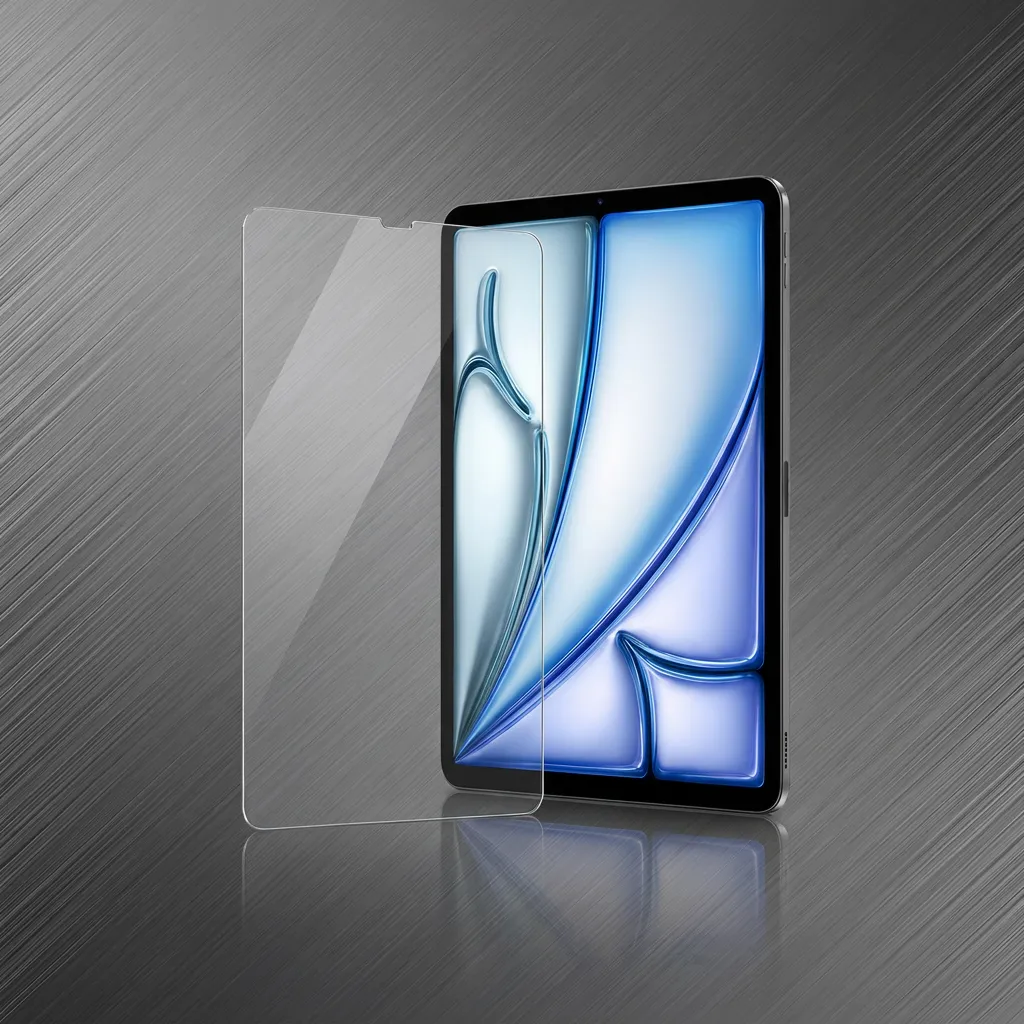
When comparing an iPad privacy screen protector for an iPad Pro 13 inch, the wording can look stronger than the evidence behind it. A product title may mention a 360° Privacy Screen Protector, 4-Way Anti Spy Screen Protector, privacy screen filter, anti-glare surface, and a viewing angle such as +/- 15 degrees in the same buying path. For a specification learner, the practical question is not whether one phrase sounds more secure. The useful question is how each phrase describes screen visibility, viewing direction, and the limits of physical side-view reduction before choosing an iPad screen protector for daily use.
In privacy screen protector wording, “360°” usually signals privacy coverage around more than one viewing direction, while “4-Way” usually suggests reduced visibility from left, right, top, and bottom angles. These terms are more commercial and descriptive than laboratory definitions unless a test method, angle standard, or optical measurement report is supplied. In a typical product comparison, “360° privacy” does not mean the iPad becomes unreadable from every possible position. It means the product is being presented as a privacy screen filter designed to narrow the visible viewing area beyond simple side-only privacy. That distinction matters because iPad use often involves portrait and landscape rotation, so a buyer may care whether privacy behavior is described horizontally, vertically, or in both orientations. “Anti spy screen protector” is also a marketing-facing phrase rather than a guarantee of information security. It helps describe the intended benefit: reducing casual shoulder-surfing or side glances when the screen is viewed outside the intended angle. It should not be read as protection against screenshots, screen recording, malware, shared accounts, mirrored displays, weak passwords, or someone standing directly in front of the screen. Industry privacy screen products are commonly explained around limiting viewing angles so nearby people see a darkened or less readable screen from the side. That concept is useful, but it is still a physical visibility control. It reduces exposure under certain viewing conditions; it does not replace device security, good data handling, or careful use of sensitive content. For the LUSA DESIGN iPad Pro 13 inch privacy screen protector, the wording combines “360°,” “4-Way anti-peep,” and “anti spy” ideas in one product presentation. A careful shopper should treat those terms as signs of intended privacy direction coverage, then continue reading for the actual device fit and angle statement. The same item is positioned for Apple iPad Pro 13" 7th 2024 M4 / 8th 2025 M5, with a separate visible variant line for iPad Air 13 inch models. That fit boundary is commercially important because privacy behavior is only useful if the film aligns correctly with the display area, bezels, camera and sensor areas, and the way the iPad is held.
A +/- 15 degrees privacy claim is best understood as a stated viewing-angle boundary around the front-facing viewing position. In plain terms, the strongest visibility is expected near the center viewing position, while visibility should become more restricted as the viewer moves outside the stated angle range. For a buyer, this kind of claim is more concrete than a phrase like “anti spy,” but it still needs conservative reading. Without a named test method, lighting condition, screen brightness level, distance, and pass/fail threshold, +/- 15 degrees should not be treated as a universal result that will behave identically in every room or at every brightness setting. The commercial value of the angle claim is that it helps shoppers compare intent, not that it proves total secrecy. A narrow privacy window can support people who frequently rotate an iPad, read documents, or browse accounts in shared spaces, but real visibility depends on display brightness, ambient light, the color contrast of the content, viewing distance, and whether the device is in portrait or landscape orientation. A white spreadsheet on high brightness may remain easier to detect than a dark interface at lower brightness. A person close to the user may see more than someone farther away. This is why a privacy screen protector should be chosen as a visibility-reduction layer, not as a standalone privacy policy. For buyer decision-making, the useful reading sequence is simple: first identify the device model, then separate direction terms from angle terms, then look for any wording that appears inconsistent. If “4-Way” suggests privacy from four directions but another section refers to horizontal privacy or 2-way privacy, the buyer should not silently merge those claims into one stronger conclusion. The more careful interpretation is that the product copy contains multiple privacy descriptors, and the angle statement is only one part of the claim. Before purchase, it is reasonable to confirm whether the intended use is mainly landscape side privacy, portrait privacy, or a broader four-direction privacy effect.
Mixed terms appear because screen protector copy often combines category keywords, feature labels, comparison text, and model-specific selling points. A phrase such as “360° Privacy Screen Protector” may be used in a title because shoppers search for broad directional privacy. “4-Way Anti Spy Screen Protector” may be used to communicate top-bottom and left-right privacy in a more direct consumer phrase. A comparison area may then use a different label such as horizontal privacy or 2-way privacy because it follows another template, compares a related product type, or compresses privacy behavior into a shorter label. The buyer’s job is not to resolve that wording gap alone; it is to avoid treating all phrases as cumulative proof of a stronger result.
The safest way to read marketing terms is to translate them into a visible-window question: from which directions is the screen intended to become harder to read? “360°” and “4-Way” both point toward broader directional privacy, but they do not say who can read the screen at the center, how dark the side view becomes, or how performance changes under bright light. “Anti spy” adds a familiar retail label, but it should still be tied back to viewing angle control. For LUSA DESIGN, these terms can help a shopper understand the product category, yet they should not be treated as certification wording, enterprise security evidence, or a promise that sensitive information can never be seen.
The +/- 15 degrees wording gives the reader a more specific boundary, but it does not automatically settle a conflict between “4-Way” and “Horizontal Privacy (2 Way)” style wording. If the same buying path contains both broader directional language and a narrower horizontal label, a conservative reading is necessary. The angle may describe the central privacy window, while the 2-way or 4-way wording may describe directional design intent. Without a clarified manufacturer explanation or test document, the buyer should keep both possibilities open. That does not make the product unusable; it simply means the final decision should be based on the most cautious interpretation of the published claims. This conservative approach is especially important because privacy screen protectors sit between convenience and security. NIST guidance for mobile devices discusses the need to manage mobile-device security risks in broader enterprise settings, and FTC business guidance emphasizes protecting personal information through practical safeguards. Those references support the broader risk awareness, not a claim that any specific iPad privacy screen protector satisfies a formal security program. For a practical buyer, the conclusion is direct: use a privacy screen protector to reduce casual visual exposure, but continue using passcodes, Face ID settings, app permissions, careful screen brightness, and common-sense handling of private content.
A 360° Privacy Screen Protector, a 4-Way Anti Spy Screen Protector, and a +/- 15 degrees privacy claim are connected terms, but they should not be read as identical. “360°” and “4-Way” describe directional privacy intent; “anti spy” describes the consumer benefit; “+/- 15 degrees” gives a more specific viewing-angle statement, but only within the limits of the available product wording. For the LUSA DESIGN iPad Pro 13 inch privacy screen protector, the sensible next step is to verify model fit, read the privacy direction terms cautiously, and avoid treating physical screen dimming as absolute information security.
Q:What does 360° privacy mean on an iPad screen protector product page?
A:360° privacy usually means the product is being marketed as reducing screen visibility from multiple directions, not only from the left and right sides. It should be read as a directional privacy claim for the viewing window, not as a promise that the screen is invisible from every angle or under every lighting condition.
Q:Is a 4-Way anti spy screen protector always stronger than a regular privacy screen protector?
A:Not always. A 4-Way anti spy screen protector suggests privacy control from left, right, top, and bottom directions, while a regular privacy screen protector may focus mainly on horizontal side views. Strength still depends on the actual optical design, viewing angle, brightness, lighting, and whether the product provides a clear test basis.
Q:How should I read a +/- 15 degrees privacy claim when the page also says 2-way privacy?
A:Read +/- 15 degrees as a stated viewing-angle boundary, then treat the 2-way privacy wording as a possible narrower directional description. If the same product wording also mentions 360° or 4-Way privacy, do not combine the terms into a stronger promise. Use the most conservative interpretation and confirm the intended privacy direction before purchase.
Privacy Screen Protectors | Privacy Protection | 3M US
SP 800-124 Rev. 2, Guidelines for Managing the Security of Mobile Devices in the Enterprise | CSRC
Protecting Personal Information: A Guide for Business | Federal Trade Commission
LUSA DESIGN Upgrade 360° Privacy Screen Protector for Apple iPad Pro 13 inch