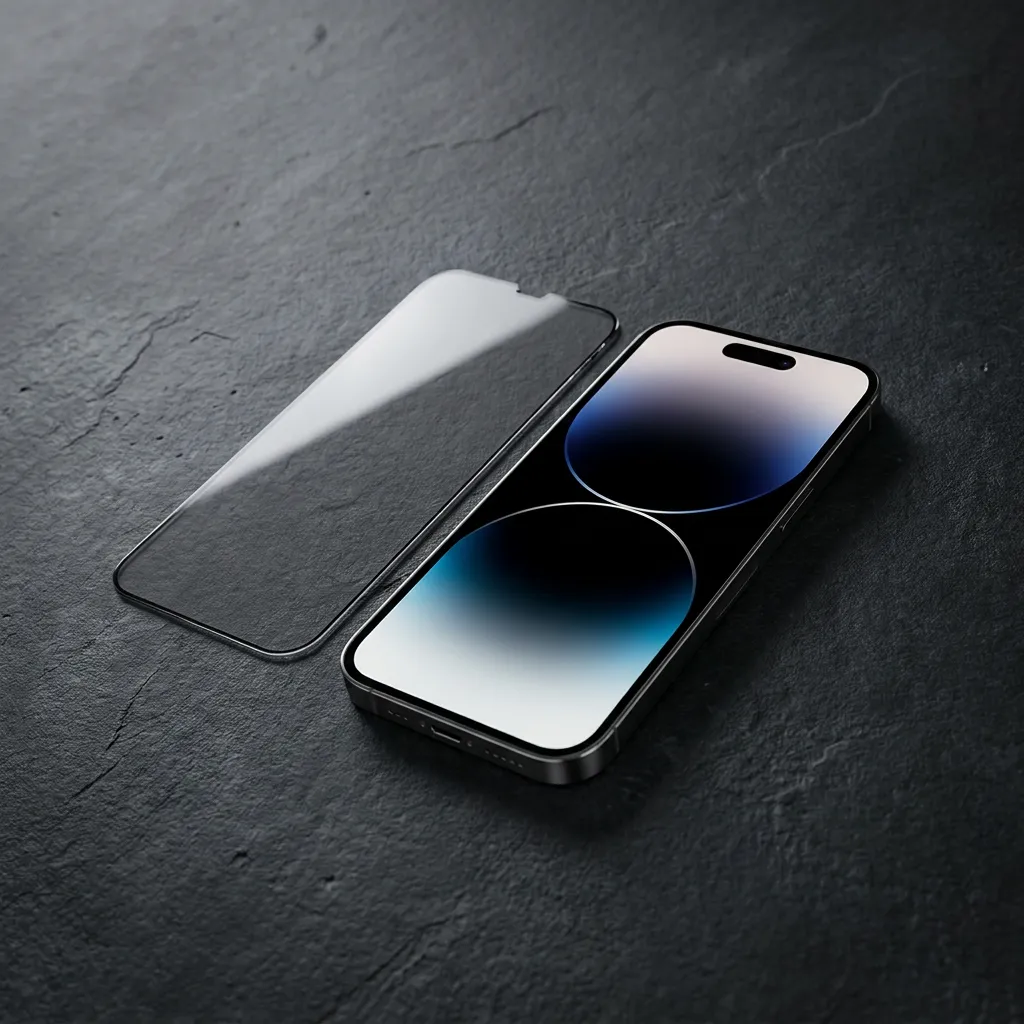
You are replying to a work message on the train when the passenger beside you turns toward the screen. A privacy protector should make that casual glance less useful, but product pages often describe the effect with labels such as 20°, 30°, 180°, or 360°. Those numbers sound precise while leaving an important question unanswered: what will the protector actually feel like in daily use?

For an iPhone privacy screen protector, a narrower viewing area can provide stronger side privacy, but it can also demand more careful positioning. A wider front viewing area can feel more natural while still limiting the view from adjacent seats.
This guide explains how to compare 20-degree and 30-degree options, why angle labels are not always presented in the same way, and what to verify before buying.
A phone privacy filter controls the direction in which display light can be viewed. From a centered position, you can read the screen. As a viewer moves farther to the side, the content becomes darker or harder to distinguish.
The privacy layer is intended to reduce casual visual access. It does not encrypt your data, hide the screen from someone standing directly behind you, or replace good habits such as locking the phone and avoiding sensitive tasks in crowded areas.
Your experience also depends on:
That is why a number on the package should be treated as one part of the decision, not the whole decision.
A product described as having 20° side privacy is generally designed to restrict visibility once someone moves outside a relatively narrow front area. In practice, a narrow angle may appeal to users who routinely handle private information in crowded environments.
One LUSA DESIGN listing describes a 20° left-and-right anti-spy design for the iPhone 16 series. The page says the protector uses 0.33 mm high-aluminum glass, an AR anti-reflection coating, a full edge-to-edge silk-print design, an oleophobic layer, and a second-generation dust-free installation chamber. It lists options for iPhone 16, 16 Plus, 16 Pro, and 16 Pro Max.
Those details make the product relevant for people who want a narrow stated privacy angle together with tempered glass and an assisted installation method. They do not establish how every 20° product will perform.
A protector described around a 30° viewing angle typically offers a somewhat broader centered view before the side image becomes restricted. That can make the screen easier to use when your grip or position changes, while still limiting what a nearby passenger can see from the side.
The LUSA DESIGN 180° privacy protector listing describes a balanced 30° viewing angle with side blocking at 30° left and right. The same page lists an AR anti-reflective layer, an oleophobic coating, scratch resistance, dust-free installation, and more than 95% light transmission. Its model options include selected iPhone 15, 16, and 17 versions.
Again, those specifications apply to that listing. Another 30° privacy protector may use a different material, coating, or measurement method.
These numbers do not always describe the same thing.
Sellers may measure from the centerline, across the total visible cone, or at a particular point where the image becomes dark enough to meet their standard. Without a diagram, two numbers may not be directly comparable.
Before buying, look for a product image or description that answers these questions:
If the listing does not clarify these points, ask the seller rather than assuming that the smallest number is automatically best.
Adjacent passengers are the main privacy concern on public transit. A narrower viewing angle may provide a stronger boundary when people are sitting shoulder to shoulder. The tradeoff is that you may need to hold the phone more directly in front of you.
A 30° design may feel more forgiving when the vehicle moves or you change your grip. It can still reduce casual side viewing while allowing a little more flexibility.
In an open office, people may pass beside your desk or sit diagonally across from you. A horizontal privacy protector can reduce side exposure, but it may not block someone directly behind you.
If you regularly show your phone to a coworker, a very narrow view can be inconvenient. Consider whether you value maximum individual privacy or easy screen sharing more often.
In cafés, airport gates, and waiting areas, seating angles change constantly. A privacy protector helps with nearby side views, but physical positioning still matters. Sit with a wall behind you when possible and avoid displaying sensitive information in a wide-open area.
People rarely hold a phone at a mathematically perfect angle. If you check directions while walking or use the phone one-handed, a slightly wider centered view may be more comfortable. A privacy screen that is too restrictive for your routine may encourage you to raise the brightness or repeatedly reposition the phone.
Privacy protection works by controlling light, so it can affect the display experience. The amount varies with the design.
Check these specifications separately:
Do not assume a privacy screen must be extremely dark. Also do not assume a product will remain identical to bare glass. The goal is a usable front view with reduced side visibility.
You can perform a simple real-world check without relying on marketing photos.
You are looking for a balanced result: the front view should remain comfortable, while the side view becomes difficult to read at the position you care about.
Do not test only in a dark room. Bright sunlight, office lighting, and a high display setting can change the visible result.
Match the full model name. An iPhone 16, 16 Plus, 16 Pro, and 16 Pro Max require different fits. Camera and sensor areas, screen dimensions, and edge shapes can differ.
If drop and scratch protection are priorities, review the glass or film construction. The 20° LUSA DESIGN listing specifies 0.33 mm high-aluminum tempered glass with double reinforcement. A flexible privacy film will have different strengths and handling characteristics.
Dust and misalignment can ruin an otherwise good protector. Both LUSA DESIGN examples discussed here describe assisted dust-control installation systems. Follow the exact instructions included with the model you purchase.
Full-coverage protectors should still leave enough room for the case. Check the edge design and install the protector before fitting a tight case unless the instructions say otherwise.
If you edit photos, watch video, or use your phone for long reading sessions, front-view clarity may matter more than the narrowest possible privacy angle. Choose the solution that supports your most common task.
Consider a 20° privacy protector if:
Consider a 30° privacy protector if:
The answer is not simply “20° is stronger” or “30° is clearer.” Measurement methods and product construction differ. Compare the full listing and test the real viewing behavior.
Not necessarily. It may indicate a narrower view, but only if the products use the same measurement method. Material, brightness, orientation, and the observer's position also affect privacy.
Yes, depending on the product. Many 180° privacy protectors focus on left-and-right viewing. A person directly behind you may remain within the front viewing direction.
It can change perceived brightness because the filter controls light direction. Product construction, screen settings, and ambient light determine how noticeable the change is.
No. Multi-direction privacy can be useful when people may view from above or below, but it can also make the screen less forgiving when you tilt the phone. Choose based on your use environment.
A properly designed protector should account for the device's sensor area, but compatibility varies. Select the exact iPhone model and check the product's cutout or full-coverage design.
Related reading: Everything You Need to Know About Privacy Screen Protectors.
The best iPhone privacy screen protector viewing angle is the one that protects the side views you actually encounter without making the phone frustrating to use. A 20° option may suit tightly packed commutes and centered viewing. A 30° option may offer a more forgiving front view while still limiting adjacent viewers.
Read the angle diagram, verify the material and model, and test the protector under realistic lighting. Privacy is most effective when the product design and your phone habits work together.
Explore LUSA DESIGN iPhone privacy screen protectors and compare the verified viewing angle, material, coating, and installation system for your device.