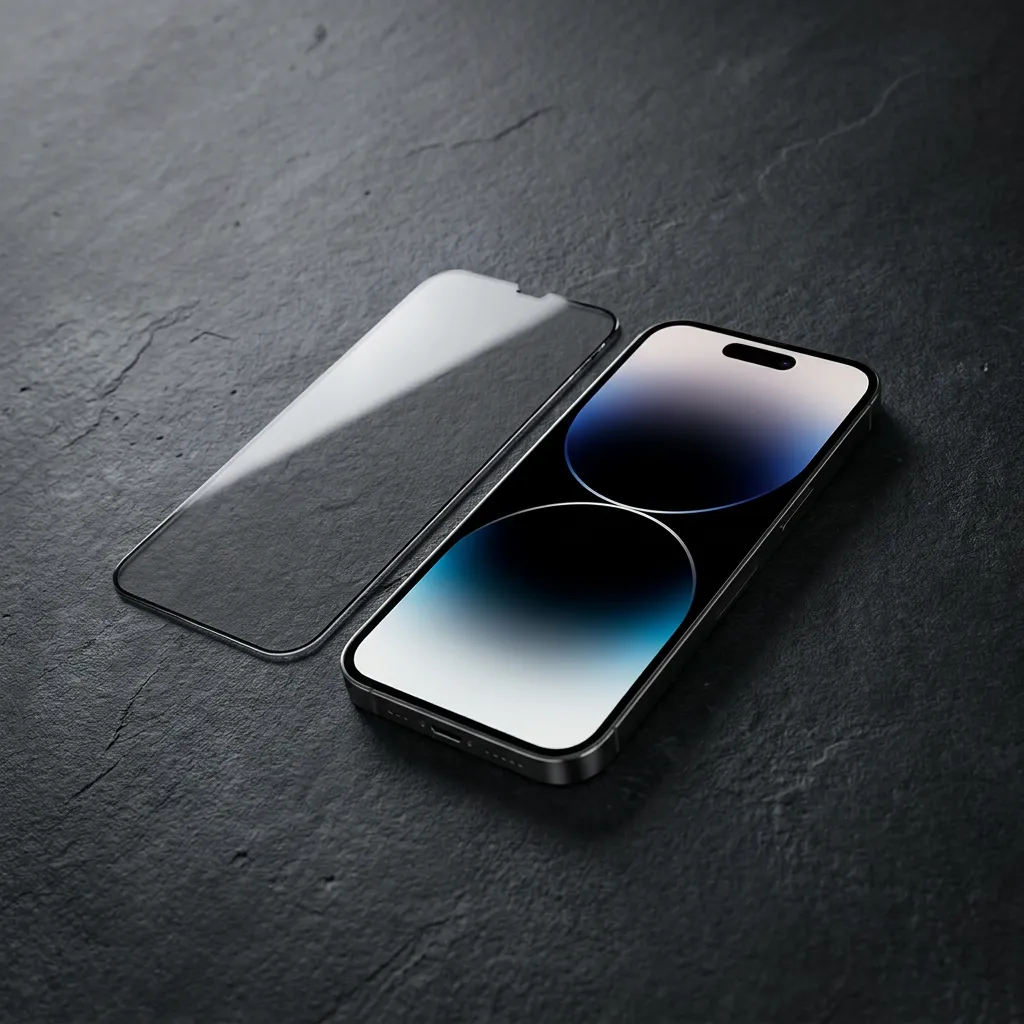
The phone arrives in a box with nothing on the screen. Four hours later it is in a pocket with keys, face down on a cafe table, and lit up on a train seat next to a stranger. That is the window in which you decide what goes on the glass.
The 20 degree anti-spy film for the iPhone 18 Pro Max makes six claims on its product page. Most people read those as marketing. They are specifications, and each one has a physical meaning you can check, plus a limit the page does not spell out. This is the read-through.
Every iPhone generation brings a new panel and the same three questions: does the film fit the glass, does the edge survive a case, and does the picture still look like the picture you paid for.
What changed on the Pro Max is the amount of screen. A larger phone means more off-axis viewing at the same distance, which makes a narrow privacy cone more useful than it was on a small phone. It also means the film is a bigger optical surface, so any haze or reflection has more room to show.
A privacy film is thousands of microscopic opaque blades standing inside the adhesive, like window blinds built at a scale you cannot see. Light leaving the panel straight ahead passes between the blades. Light leaving at 40 degrees hits a blade and is absorbed.
The 20 degree number describes the clear cone, so it is about 10 degrees to each side of centre. At a normal 30 cm holding distance, that cone is roughly 10 cm wide, wider than the screen. At 50 cm on a table, it is about 17 cm wide. Your eyes stay inside it; the person one seat over, 80 cm laterally, is far outside it.
What it does not do is block the person behind your shoulder. A louver filters by angle, and a person standing behind your head is looking from the front, at a shallow angle. If that is your threat model rather than the passenger beside you, a four-way 360 degree film is the tool, and it will dim the screen more.

Privacy films have a reputation problem, and it is optical rather than imaginary. The louver already removes light, so manufacturers who want a cheap film stop there. The result is a screen that looks slightly grey in a bright room and mirrors the window behind you, because the film's own glossy surface adds reflection on top of the glass.
An anti-reflective coating fixes that separately. It is a stack of four to eight dielectric layers, each about a quarter wavelength thick, arranged so reflections from the layer boundaries return out of phase and cancel. Bare glass reflects around 4 percent of the light hitting it; a good stack below 1.5 percent. Nothing is blocked. The reflection is subtracted.
That is what true-to-screen means here: not brighter than the panel, but no added sheen of its own. In practice, blacks stay black instead of washing toward grey, and the picture does not turn into a mirror when you step outside. If the difference between the two effects is new to you, we wrote a longer piece on privacy film versus AR film.

Tempered glass works as a sacrificial layer. A scratch that would have landed on the panel lands on the film, and a chip at the edge takes the damage instead of the glass underneath.
Two honest notes. First, when a listing quotes 9H, that is surface hardness on the pencil scale, which measures scratch resistance. It says nothing about drop protection. Second, impact failures start at the edge, because that is where the glass has least support. A 1.5 m corner drop onto tile is still a case problem, not a film problem.
What the film does buy you is the everyday category: keys in a pocket, a phone face down on a granite counter, a zipper pull dragged across the screen.
2.5D is a description of the film's edge profile. The outer millimetre is polished into a curve instead of being cut flat.
That sounds cosmetic until you live with a flat cut. A 2D edge is a 90 degree corner of glass: it catches light as a bright rim, it feels sharp against a thumb swiping back, it chips, and it lifts where a case pushes against it. It also leaves a gap wide enough for dust to collect in a visible line.
The edge also explains the light leak. A flat cut lets light escape sideways out of the glass, which shows up as a bright border at night. A curved edge bends that light back into the panel.
The installation tray is the least glamorous part of the product and the one that decides whether you like it. The film comes pre-aligned on a frame; you drop the phone in, pull the tab, and a roller presses the glass down as the protective layer is dragged away.
Alignment comes from the frame, not your hands. That matters more than it sounds: half a millimetre off centre on a Pro Max leaves an uneven border that you will notice every day for a year.
Dust is the other half of the problem. A single speck under the glass lifts the adhesive around it and leaves a permanent bright dot against a dark screen. Do the install in a bathroom after a hot shower, wash your hands, work on a hard table, and pull the tab in one slow motion rather than three short ones.

The oleophobic layer is a fluorocarbon coating that lowers surface energy. Oil from your fingers beads instead of spreading, so a thumbprint stays a thumbprint instead of becoming a haze across the whole panel. It also reduces the friction that makes a swiping thumb feel sticky on bare glass.
This coating is the part that wears. Daily swiping and pocket abrasion thin it over six to twelve months, and alcohol wipes strip it much faster. Clean with a dry microfibre for dust and a barely damp cloth for grease, and the coating will outlast the average upgrade cycle.
The Pro Max version is $19.99 for one, $29.99 for two, and $37.99 for three, which works out to $19.99, $15.00 and $12.66 per unit.
| Bundle | Price | Per film | Who it fits |
|---|---|---|---|
| 1 pack | $19.99 | $19.99 | One phone, and you are confident in the install |
| 2 pack | $29.99 | $15.00 | Two phones, or one spare for a botched first attempt |
| 3 pack | $37.99 | $12.66 | Two Pro Maxes in the house, or a partner's phone |
The third film costs eight dollars more than the first. Given that the most common way to lose a film is a dust speck on attempt one, the arithmetic usually argues for two.
Does the 20 degree film interfere with Face ID?
No. Face ID reads infrared, and the louver stack is cut around the sensor area. Unlocking behaves normally.
Is 20 degrees too narrow for watching video?
For one viewer holding the phone, no. It stops working when two people watch together, which is the point.
Will it fit under a case?
Yes. The 2.5D edge profile is made for case clearance, but check a thin-lipped case first if the fit is tight.
Can I take it off and reapply it?
No. The adhesive is single-use; removing it leaves dust and a stretched silicone layer.
Does it fit the iPhone 18 Pro as well?
No. The Pro and Pro Max are different sizes with different cuts. The same film exists for the iPhone 18 Pro, and the variant selector on the product page switches between them.
Why does my screen look dimmer?
Because it is. A privacy layer blocks light in all directions, including the one you are looking from. The AR layer keeps the picture clean; it cannot add brightness the panel is not emitting.
What you are buying is not a privacy filter; it is a filter that stays clear. The 20 degree cone does the hiding, the AR stack stops it looking grey, the tray keeps dust out, and the oleophobic layer keeps it usable. Each one fails on its own, and most cheap privacy films fail at least two.
Tell us how you hold the phone and who sits next to you, and we will tell you whether 20 degrees is the right grade or whether 180 degrees suits you better. See the iPhone 18 Pro Max 20 degree anti-spy screen, or browse every privacy film we make.