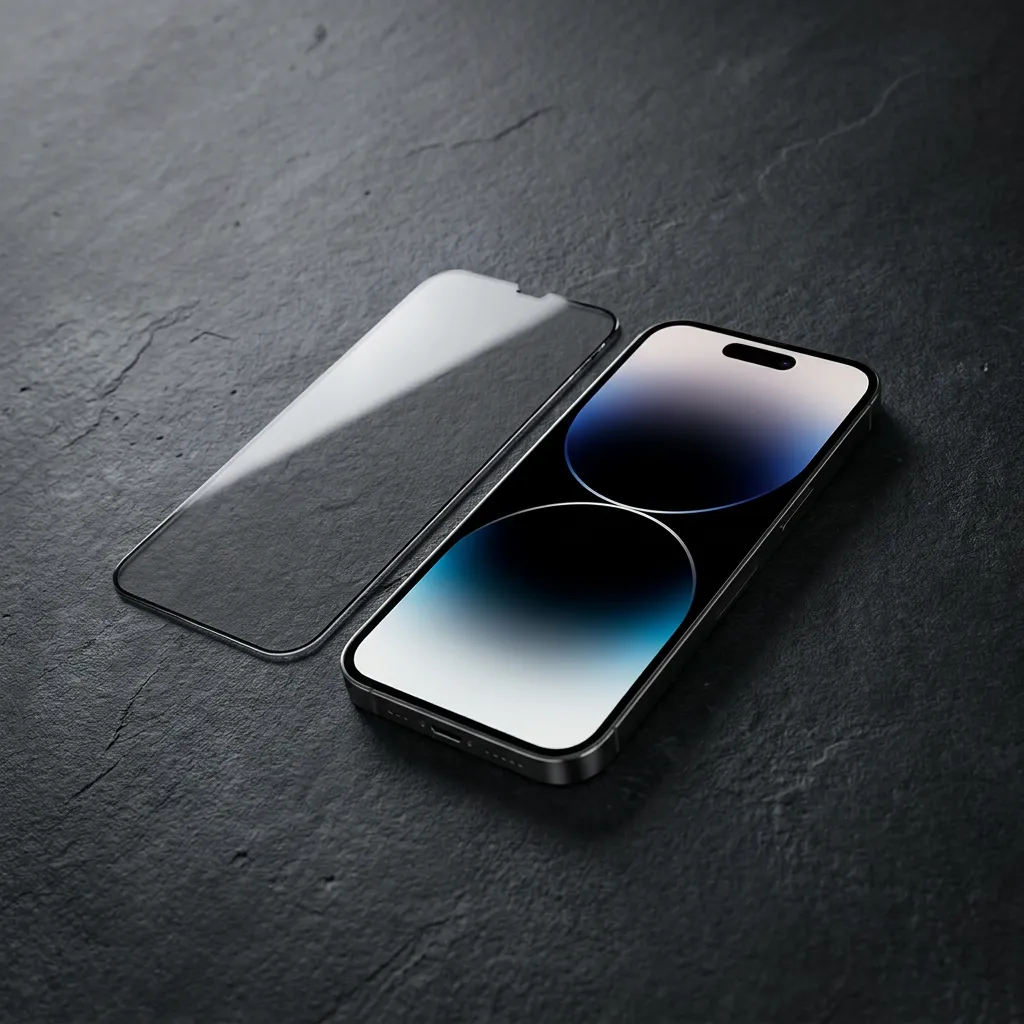
Two people bought a protector for the same phone last week. One is annoyed that the screen turns grey in daylight. The other is annoyed that the man on the train can read her messages. Both bought a product described as a phone screen protector, and both bought the wrong one for their problem.
Privacy film and anti-reflective film are not two grades of the same thing. They do two different optical jobs, and the way they are marketed makes them sound interchangeable. Here is the short, honest version.
Both end up glued to the same piece of glass. Under a microscope they could not look more different.
A privacy film contains a louver structure: thousands of thin opaque blades standing inside the adhesive layer, like miniature window blinds. Light leaving the screen straight ahead passes between the blades. Light leaving at 30 or 40 degrees hits a blade and is absorbed. The display itself is untouched; the film only decides which directions are allowed to see it.
An AR film is a stack of four to eight dielectric layers, each about a quarter wavelength thick. Reflections from the layer boundaries return out of phase and cancel each other. Bare glass reflects roughly 4 percent of the light that hits it; a good AR stack takes that below 1.5 percent and lets around 98 percent through. Nothing is blocked. The reflection is subtracted.

| Privacy film | AR film | |
|---|---|---|
| What it solves | People reading your screen | Glare, reflections, the mirror effect |
| How it works | Louver blades absorb angled light | Coating cancels reflected light |
| Front brightness | 55 to 75 percent | 97 to 99 percent |
| Side view at 45 degrees | Almost black | Unchanged, just clearer |
| Surface reflection | Tends to get worse: one more glossy layer | Below 1.5 percent |
| Screen in direct sun | Dim and grey | Readable, with better contrast |
| Strongest use | Commuting, shared desks, travel | Outdoors, photography, night use |
| Price | Lowest | Middle |
The case for privacy film is not paranoia, it is geometry. On a train, a bus, a plane, in a lecture hall or a waiting room, the person next to you is 40 cm from your screen and has nothing better to look at.
This is not a hypothetical. A 1,173-participant study on visual privacy found that after a single glance, participants could reconstruct on-screen content 64 percent of the time, and close to 80 percent after two glances. Two glances are what a stranger gets in the ninety seconds before your stop.
The cost is brightness, and it is real. If you normally run the phone at 60 percent indoors, a privacy film pushes you to 90. Outdoors, sun glare and louver absorption stack: the panel fights the sky and the film at the same time, and the screen looks washed out. That trade is the single most common reason people return a privacy film, and it is why the dimmer-screen question never goes away.
It is also why a film with AR underneath changes the calculation. Our 20 degree AR privacy screen for iPhone 18 Pro keeps reflectance under 1.2 percent and transmission near 98 percent, so the privacy layer is not also costing you the reflection fight.
AR is not about hiding. It is about seeing. Outdoors, a phone screen loses contrast mostly to reflected sky, not to the limits of the panel. That is why a modern phone at 1,500 nits can still look grey on a sunny sidewalk: you are looking at the sky with your messages printed on it.
AR wins in specific, recognisable situations:
Our HD anti-reflective screen for iPhone 16 Pro and 17 is the plain version of that, and the anti-glare / AR two-pack is for people who want the reflection gone on two phones at once.
One clarification that saves a return: AR is not matte. Matte scatters light, which removes glare and softens every letter on the screen. AR cancels reflection and keeps the panel sharp. If you look at a white page and it has a slight haze, you bought matte.
Most people who ask us this question need both. Reading a work message on a train is a privacy problem; reading the same message on a sunny platform is an AR problem, and the same phone does both inside four minutes.
A hybrid film stacks an AR coating over a narrow louver: the coating handles reflected light, the louver handles the angle. The 20 degree number describes the clear viewing cone, so roughly 10 degrees either side of centre. At a normal 30 cm holding distance that cone is about 10 cm wide, comfortably wider than the screen itself, and it collapses to black about one seat over.
The trade-offs are honest ones. It costs more than either single-purpose film, and if you use the phone flat on a desk or take video calls with the phone propped up at an angle, the picture dims when you move off centre. For a phone you hold in your hand, that is a fair exchange.
Angle numbers are usually explained badly. On a phone, they matter less than they do on a laptop, because a phone is a one-person screen at 30 cm.
| Grade | What it blocks | Makes sense when | Gets annoying when |
|---|---|---|---|
| 20 degree | Anything off centre by more than about 10 degrees | You commute, travel, or work in public | You show someone a photo at arm's length |
| 180 degree | Left and right, but not the front | You want privacy from neighbours, not from the person you are talking to | Someone stands behind you |
| 360 degree | All four directions | The phone lies flat on a table in a meeting or a cafe | You use the phone in your hand all day and lose brightness for nothing |
So: a 20 degree film for a phone in your hand, a 180 degree AR privacy film when you still want to hand the phone across a table, and a 360 degree film only if the phone spends its day face up on shared surfaces. If the angle naming is still fuzzy, the angle guide explains the two different scales the industry mixes.
| Your day | Buy | Why |
|---|---|---|
| 40 minutes on a train or bus, phone in hand | 20 degree AR privacy | Shoulder height is exactly the leaked angle |
| Outdoor video, drone, hiking, beach | HD AR | Reflected sky is the whole problem |
| Phone mounted in a car all day | AR or anti-glare | Windshield reflection never stops |
| Open office, phone face up on the desk | 360 degree | People approach from every side |
| Showing clients photos, quotes or plans | 180 degree AR privacy | Block the neighbours, keep the front clear |
| Gaming and streaming at home | HD AR or the two-pack | Nobody is reading over your shoulder on the sofa |
Dust, not optics. Most one-star reviews of AR films are dust trapped under the glass, seen as a bright speck against a black screen. A dust-free installation tray and a 10 second alignment step solve more complaints than any coating upgrade. It is worth choosing a film that ships with the tray.
Coating care. An AR stack is softer than the glass under it. Alcohol wipes and paper towels slowly strip it; a dry microfibre for dust and a barely damp cloth for grease is all it needs. Keep the phone out of a pocket shared with keys if you care about the coating rather than the glass.
Does a privacy film really reduce brightness?
Yes. Expect to lose a quarter to a third of perceived brightness, more in sunlight. That is the physics of blocking light, not a defect in the film.
Can I put an AR film over a privacy film?
No. You would double the thickness, hurt touch response, and still be looking through a louver. Pick one film.
Is AR the same as matte?
No. Matte scatters reflection and softens text. AR cancels reflection and keeps text sharp.
Does AR film interfere with Face ID or touch?
Not at all. Facial recognition reads infrared through the glass, and a coated film is a fraction of a millimetre thick.
Will a privacy film damage my eyes?
The film emits nothing. Discomfort usually comes from a dimmer screen and the squinting that follows, which is why an AR-backed privacy film feels easier than a plain one.
Which one is better at night?
AR. At night your enemy is a lamp reflected in the glass, and a louver does nothing about that.
Look at what is on the other side of your screen. If it is eyes, buy privacy. If it is light, buy AR. If it is both, buy 20 degree AR privacy.
That is the whole decision, and it takes less time than reading a spec sheet. If you are still unsure, tell us where you use the phone for two hours a day and we will pick for you. Browse privacy films or browse anti-reflective films.