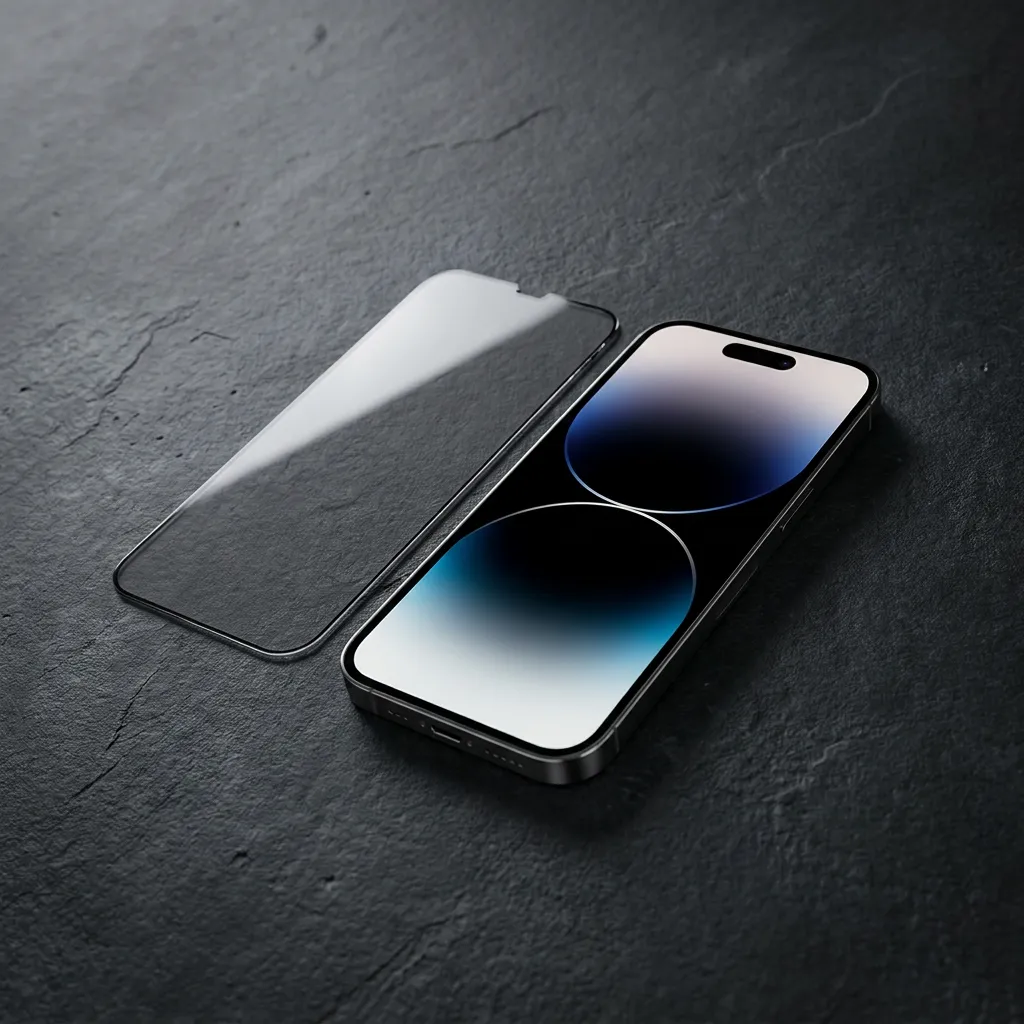
You pick up your phone and notice a thin crack running across the screen protector. The phone was not dropped, the display was working normally, and there was no obvious impact.
This can make the crack appear completely random. In most cases, however, the protector has been exposed to pressure, bending, edge damage, temperature changes, or a small earlier impact that was easy to miss.
Glass does not always fail at the exact moment damage begins. A tiny chip or scratch can weaken one area, and the visible crack may develop later when the glass is placed under additional tension. Corning explains that glass failure begins when flaws on the surface propagate under tensile stress. Its strengthened cover glass is specifically designed to retain more strength after minor scratches and damage.
Understanding why this happens can help you determine whether the protector needs to be replaced and how to prevent the same problem from happening again.
A protector does not usually crack without any physical cause. The cause may simply be less obvious than a direct fall.
Tempered glass is held under internal compressive stress as part of the strengthening process. This structure improves damage resistance, but the finished glass can still break when a flaw, chip, pressure point, or bending force creates enough local stress.
Corning notes that any glass can break under the right damage conditions or stresses, even when it has been chemically strengthened.
The most common causes are discussed below.
A screen protector may survive a small impact without showing an immediate crack.
Examples include:
The impact may create a tiny chip at the edge or a microscopic flaw in the surface. The protector may continue to look normal until later pressure causes the damaged area to spread.
Deep scratches and edge defects matter because they can reduce the amount of stress the glass can withstand before failure.
Phones are often exposed to bending and compression even when they are not dropped.
A phone in a tight pants pocket may be pressed against the body when the user sits, bends, or climbs stairs. A phone in a backpack may be compressed by a laptop, water bottle, charger, book, or other hard object.
Google specifically advises users not to keep a phone in a back pocket where it may be crushed when they sit down. It also recommends keeping phones away from keys and other hard objects that may scratch, crack, or crush the display.
A screen protector is thin and rigid. When the phone flexes slightly or pressure is concentrated in one area, the protector may crack even though the phone frame returns to its normal shape.
A case and screen protector must leave enough clearance around the edges.
Problems can occur when:
Continuous pressure from a case may produce a small chip or stress point near a corner. The crack can then travel across the protector.
Remove the case and inspect all four edges. Look for whitening, small chips, lifting, or a point where the case touches the glass.
A protector should bond evenly across the screen.
Uneven stress can develop when:
A small particle can create a raised pressure point. The surrounding glass may be forced to bend around it, increasing local stress.
Do not repeatedly lift and press the same protector during installation. Every lift increases the chance of contamination, adhesive damage, or bending.
Extreme heat and cold can affect the phone, adhesive layer, case, and protector differently.
Apple and Google recommend using many of their phones between approximately 0°C and 35°C, or 32°F and 95°F. Both companies warn against leaving a phone in an extremely hot or cold vehicle.
A protector that moves rapidly between cold outdoor air and a heated room may experience a different rate of expansion from the phone body and case. Temperature alone does not guarantee that the protector will crack, but an existing chip, tight case, or uneven bond can make failure more likely.
Examples include:
Allow a very hot or cold phone to return gradually to a normal indoor temperature.
Tempered glass is generally more vulnerable at its exposed edges than across its flat center.
A small edge chip may occur when:
Once the edge is damaged, a crack may spread with normal handling.
Reinforced or carefully finished edges can help improve resistance to chipping, but no glass edge is immune to concentrated force. Screen-protection manufacturers commonly treat reinforced edges as a separate durability feature for this reason.
Manufacturing defects are possible, although they should not be the first assumption.
Potential defects include:
A manufacturing issue is more likely when a newly installed protector cracks quickly under normal use, particularly when there is no visible impact point, edge pressure, trapped particle, or case conflict.
Document the crack with clear photographs before removing the protector. Contact the seller and review the applicable warranty or replacement policy.
Turn off the display and inspect the screen under bright, angled light.
A protector crack may show one or more of the following signs:
The phone display may also be damaged when:
Do not press hard on the damaged area to test it.
A minor isolated crack may not immediately affect the phone, but continued use has disadvantages.
The crack may:
Replace the protector when the crack reaches an edge, produces loose fragments, affects visibility, or continues to spread.
If the original phone glass is cracked, stop using the device and arrange an appropriate repair. Apple and Google both warn against using a phone with cracked or physically damaged glass because it can cause injury.
No definite conclusion can be made from the crack alone.
A protector may have taken part of an impact, but it may also have cracked because of edge damage, bending, poor fit, or concentrated pressure. A broken protector does not automatically prove that the original display would otherwise have broken.
The useful question is whether the phone screen remains undamaged and fully functional.
Similar phone models can have different screen dimensions, curves, speaker positions, and bezel shapes.
After installing the case, confirm that it does not press on any protector edge.
Sitting on a phone can expose it to bending and compression.
Do not store the phone against keys, tools, coins, metal chargers, or other rigid objects.
A dust-free installation reduces raised pressure points and uneven bonding.
Do not leave the device in a hot or freezing car. Allow it to return gradually to a normal indoor temperature.
A protector with a damaged corner or edge has already lost part of its structural integrity.
A well-fitted case with raised edges can reduce direct contact between the screen and hard surfaces. Google recommends combining a device-specific case with appropriate screen protection.
Yes. A previously damaged protector may develop a visible crack later after temperature changes, case pressure, or normal handling.
Heat exposure alone may not crack an undamaged protector, but extreme or rapid temperature changes can add stress to a protector that is chipped, misaligned, or tightly compressed by a case.
Normal wireless charging should not directly crack a compatible protector. Excessive device heat, a damaged case, or existing glass defects should be investigated separately.
Yes. A case that presses against the edge may chip, lift, or stress the protector.
Replacement is recommended when the crack is spreading, reaches an edge, creates sharp fragments, or affects normal use.
A screen protector that appears to crack by itself usually has a physical explanation. Hidden impact damage, pocket pressure, edge chips, case interference, installation stress, and extreme temperatures are the most likely causes.
Inspect the protector, case, and original screen before installing a replacement. Correct alignment and case clearance matter as much as the protector material itself.
Explore LUSA DESIGN screen-protection options made for specific iPhone, iPad, MacBook, watch, camera, and other device models.